
Barbour County VINELink Coverage
West Virginia VINE is the statewide custody-status and notification service used by the West Virginia Division of Corrections and Rehabilitation. Its coverage reaches all ten regional jails and all WVDCR correctional facilities. That includes Tygart Valley Regional Jail and Correctional Facility, the state-operated jail serving Barbour County, as well as state prisons. The shared layer matters because a person can leave Tygart Valley for a prison intake without leaving correctional custody.
VINE reports events supplied by participating agencies. A result can show a custody status, reported facility, identifying details, and a release, transfer, or other status change when available. It is an alert system, not the permanent legal file. A Barbour court docket may explain the authority for a bond or court-ordered release, while a Tygart Valley movement entry records what physically happened. The Barbour County released-inmate search and records path combines those sources when formal confirmation is needed.
Search Barbour County VINELink Records
Start with enough detail to distinguish one person from another. A full legal name is the base. An offender number, booking identifier, age, date of birth, or known facility can resolve similar names. Select West Virginia before entering the person. Then open only the result whose details fit the Barbour or Tygart Valley episode being checked.
- Open the official West Virginia VINELink person search and select the custody or offender search.
- Enter the exact first and last name. Add an identification number when the live form offers that field.
- Compare age, birth information, facility, and other visible identifiers. Do not rely on a name alone.
- Open the matching record and read the status and reported event exactly as displayed.
- Save the event details, then confirm a release or transfer with WVDCR, Tygart Valley, or the originating Barbour court.
The official search screen shows how West Virginia routes a specific-person inquiry. View the live West Virginia VINELink portal before relying on field labels, since the interface can change.

The screen establishes the correct state portal, but the matching record and later agency check establish the person's status.
Note: No search result can mean a spelling issue, delayed agency data, a transfer, or a record that is no longer displayed.
Barbour VINELink Release Fields
A VINELink record is read as a set of clues tied to one person. The public view varies by agency and episode, so not every field will appear. Preserve the wording and date shown. Do not change an agency label such as transferred, released, or out of custody into a broader claim.
| Field | What It Shows |
|---|---|
| Name and identifier | Details used to distinguish the selected person from similar matches. |
| Custody status | The status most recently reported to VINE by a participating agency. |
| Facility or location | The reported regional jail or correctional facility linked to the record. |
| Custody event | A reported release, transfer, bond, or other change when the record supplies it. |
| Event date | The date attached to the reported change, when available in the live record. |
| Notification options | The phone, text, email, or app channels offered for that record. |
A released or out-of-custody label means VINE received a change from its source. It may not explain whether the event arose from bond, time served, dismissal, parole, conditional release, or another legal authority. Nor does it guarantee that the released result will stay online for a fixed time. For a durable answer, request the Tygart Valley movement or release entry and pair it with the Barbour case record.
Register Barbour County Release Alerts
Registration must begin from the correct person's record. Available channels can include telephone, text, email, or an app. Enter the requested destination, complete the on-screen check, and retain the confirmation. For an automated telephone alert, create a four-digit personal identification number, or PIN. That PIN acknowledges the call after the status message repeats.
- Confirm that the open record belongs to the named person and correct custody episode.
- Select the notification-registration option shown on that record.
- Choose an offered phone, text, email, or app channel and enter the contact details.
- Complete the verification step. For phone notice, create the requested four-digit PIN.
- Keep the registration confirmation and use an official record to verify any later alert.
The separate WVDCR service line, 1-866-984-8463, supports custody checks and telephone registration. The official West Virginia VINE service page explains the state channel and its notification role.
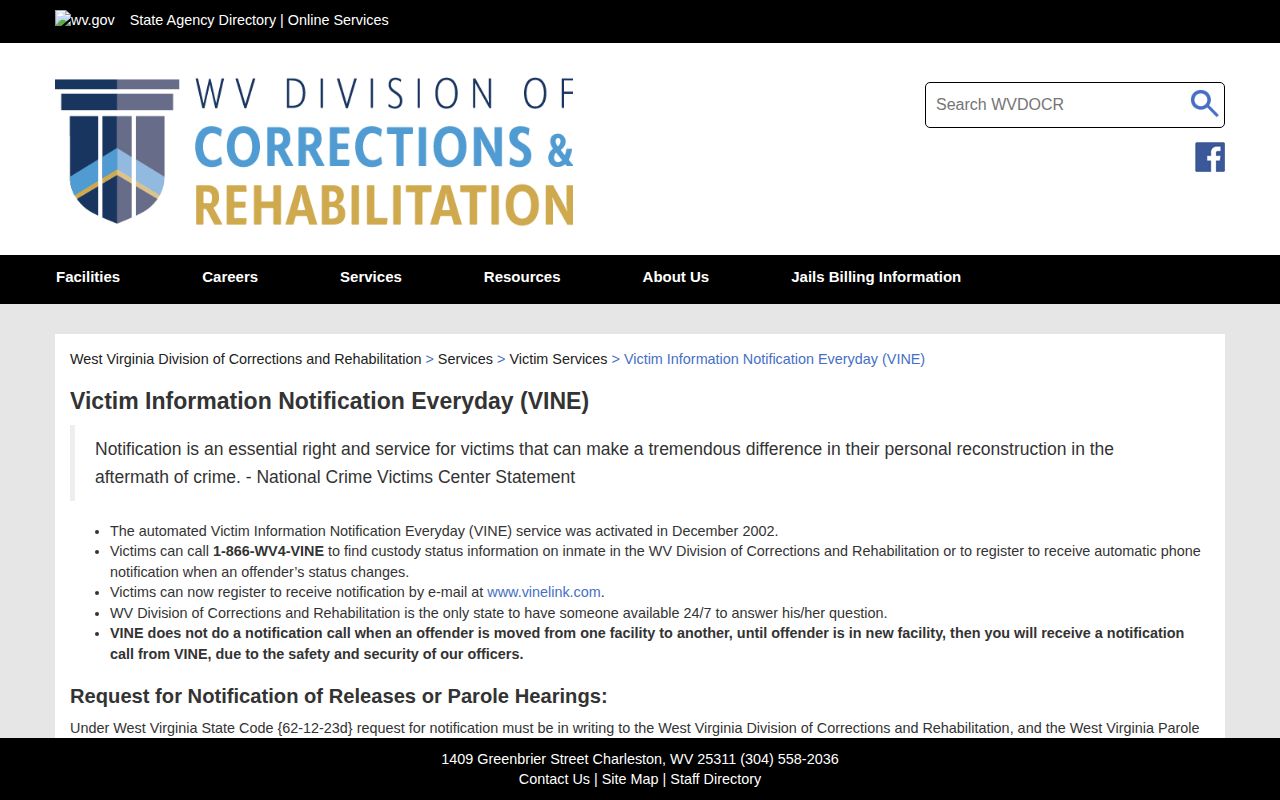
This WVDCR source confirms the phone route that serves Tygart Valley and state correctional records.
Note: Keep a phone-alert PIN private and available, since the automated call uses it to confirm that the notice was received.
West Virginia VINE Expansion
West Virginia expanded VINE to all ten regional jails and all correctional facilities by September 2019. This local layer is distinctive for Barbour County. Tygart Valley is a regional jail, but WVDCR also runs the prison system. One notification service can therefore report changes across two custody settings whose public searches and legal records are still different.
A transfer alert may lag until the person reaches the receiving facility. That delay is important at Tygart Valley because the facility houses jail detainees and people awaiting prison transfer. Leaving its regional-jail view can reflect prison intake, not freedom in the community. The state VINE expansion announcement establishes the breadth of the notification layer, while OIS and the movement record establish the actual custody path.
Read Barbour VINELink Custody Changes
Barbour County searches often begin with the Sheriff or a county court, yet custody data comes from WVDCR. The agency runs both regional jails and prisons. This split affects every VINELink result. A person held before trial at Tygart Valley usually has no computed sentence-expiration date. Bond, a dismissal, a court order, or another case event controls whether that person can leave. A sentenced state prisoner has a different record path, including an institution record, a sentence time sheet, and possible parole or conditional-release status.
Read each custody event in that setting. A community release ends the secure-custody episode, although probation, parole, conditional release, or Community Corrections may still require reporting. A transfer sends the person to another jail, prison, federal agency, or immigration authority. It does not end custody. A discharge may mean the sentence or later supervision has ended, but the agency's exact label must be preserved. VINE can announce the event without supplying all of those legal details.
The strongest Barbour County confirmation pairs two records with different roles. The Tygart Valley or WVDCR record supplies the physical movement and its time. The Barbour magistrate or circuit record supplies the order, disposition, sentence, or commitment that authorized it. If VINELink reports release but OIS still shows an active location, ask the agency to reconcile the mismatch. If both public searches are blank, the named-person records request remains available.
Identity checks remain vital across those sources. Record the full name, approximate age or birth date, offender or booking number, facility, and the Barbour case number when available. More than one custody episode may appear for the same person. A past release event can coexist with a later admission, so the date and episode must match before the alert is attached to the event being researched.
Barbour Release Notice Types
Ordinary VINELink registration is not identical to formal written victim notice. The WVDCR VINE material explains that a statutory request for release or parole-proceeding notice must be made in writing to WVDCR and the West Virginia Parole Board. A written request to DCR also enrolls the requester in VINE. Anyone who needs the statutory channel should follow those official instructions rather than assume a web alert completed every notice step.
- VINELink alert
- An automated notice based on a participating agency's reported custody event.
- Written notice request
- A separate formal route submitted to the agencies named in West Virginia's instructions.
- Release record
- The facility or agency event record that documents the actual movement and status.
- Court order
- The legal direction that may authorize bond, dismissal, sentence action, or release.
These channels answer different questions. The alert gives prompt notice. The release record documents the event. The court or WVDCR record explains its legal basis and whether parole, conditional release, probation, or another form of supervision continues.
A parole hearing date is not a release notice. The West Virginia Parole Board makes parole decisions, while WVDCR Parole Services supervises a person after release. Even a grant may require processing before physical departure. Likewise, a projected or minimum discharge date is a sentence calculation that can change. Registering for an event alert can help track the later custody change, but it should not be used to turn a hearing or calculated date into a promised release.
Confirm Barbour VINELink Release Results
VINELink does not establish coverage for federal Bureau of Prisons, U.S. Marshals Service, or ICE custody. A federal sentenced person must be checked through the BOP locator. A possible immigration transfer requires the ICE locator and the Tygart Valley movement record. Neither branch should be used unless the known facts point to that jurisdiction.
For the usual Barbour County case, compare VINELink with the WVDCR regional-jail OIS search. A current Tygart Valley match points to custody or a recent operational record. No match does not prove release. Call Tygart Valley at (304) 637-0382 and ask whether the named booking ended in community release or transfer. If staff cannot disclose it by phone, request the release or movement entry under West Virginia FOIA. The originating magistrate or circuit docket can then identify the bond, order, disposition, or commitment behind the change.